Does the cosmetics factory meet the international requirements for exports?
 Ouqian
 Jan 08,2026
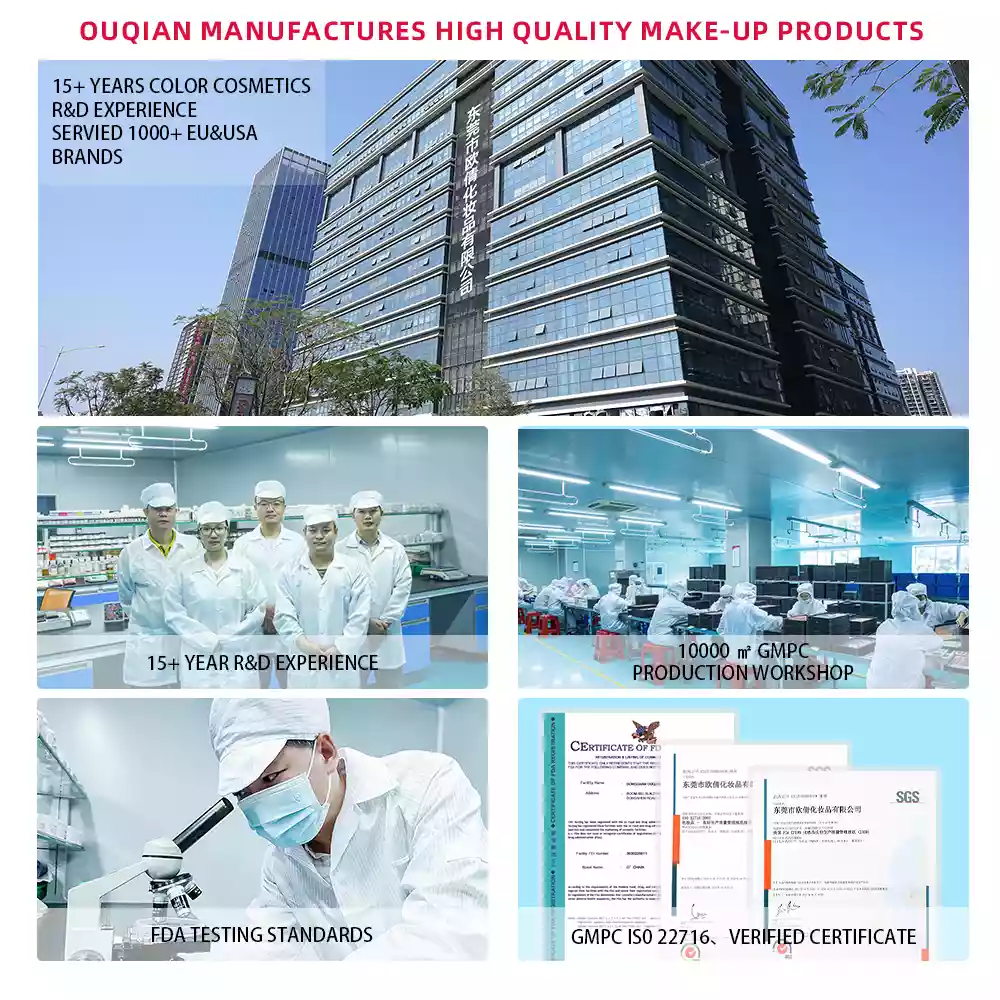
Ouqian Cosmetics factory is a professional OEM/ODM/Private Label manufacturer. R&D team with 20 years experience in color cosmetics market.
Products are accordance with FDA and EU regulation compliance, and produce in ISO22716 certified GMP workshop to ensure good quality.
All of them are made compliance with global health and hygiene standards.
Our manufacturing process is a harmonious blend of advanced technology and skilled craftsmanship.
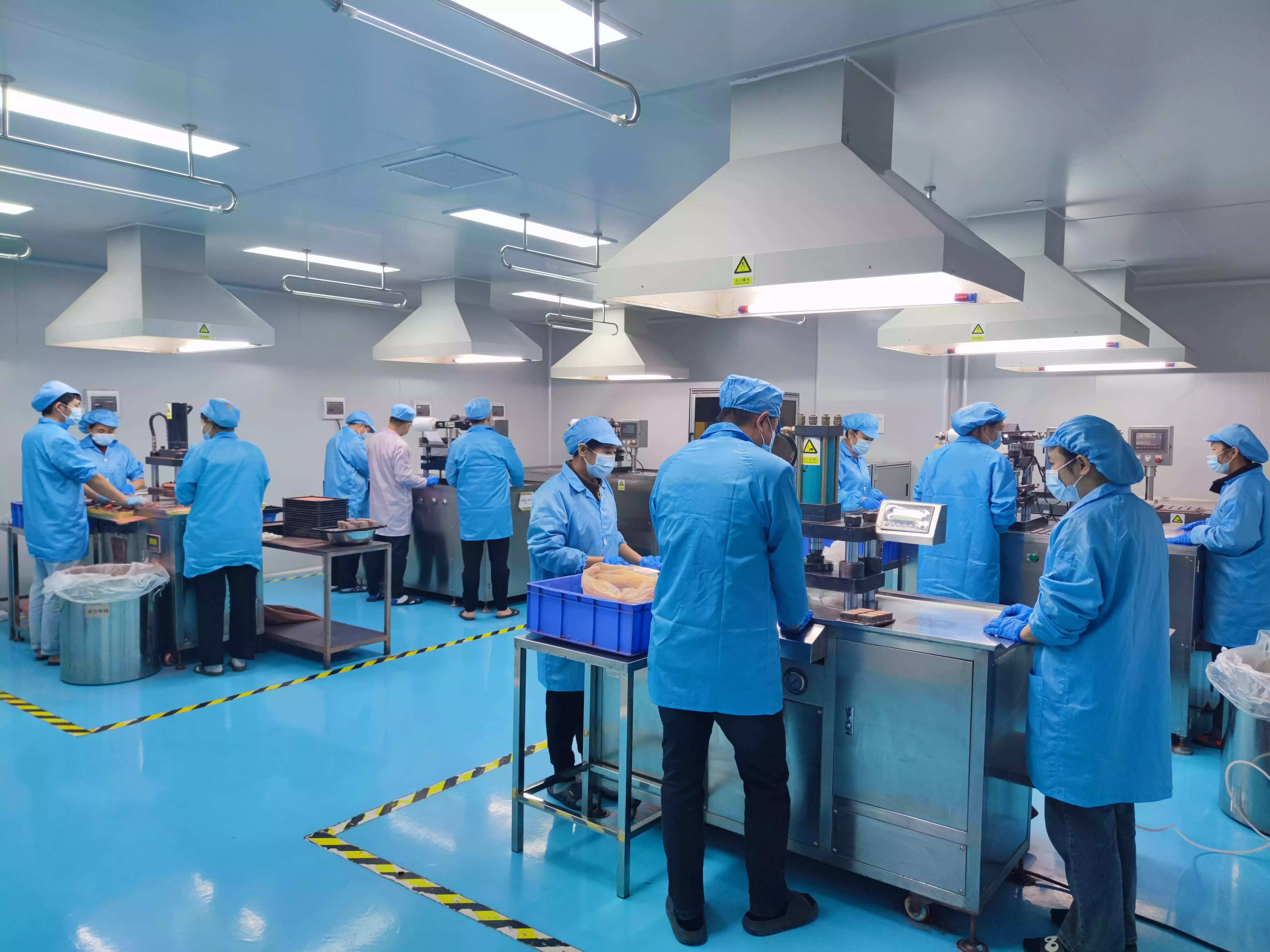
In our GMP workshops, we use automated production lines to ensure high - volume production without compromising on quality.
At the same time, our skilled workers conduct manual inspections at key stages of the production process to identify and rectify any potential issues.
Our quality control team uses a battery of tests, including microbiological testing, stability testing, and safety testing, to ensure that every product that leaves our factory is of the highest quality.
1. Does the factory's production quality management system align with internationally recognized standards?
The factory strictly adheres to the ISO 22716 Good Manufacturing Practice for cosmetics,
And benchmarks against the EU's EC 1223/2009 regulation and the relevant requirements of the US FDA to establish a full-process quality management system.
From raw material procurement to finished product shipment,
Each link is supported by standardized documents, and systematic control is implemented to ensure
That the production process complies with the mainstream global beauty export standards.
2. Does the cleanliness of the production workshop and the layout of the facilities meet international requirements?
The workshop is scientifically divided into "general area, quasi-clean area, and 100,000-grade clean area".
The key filling process meets the 100,000-grade clean standard and is equipped with air purification, temperature and humidity, and pressure difference monitoring systems.
The production process flows in a single direction, and the cosmetic and skin care production lines are physically isolated to effectively avoid cross-contamination,
Fully meeting the environmental requirements of international beauty production.
3. How can the raw material control process ensure compliance with international export standards?
Raw materials are subject to a full-process control system of "supplier audit - incoming inspection - storage zoning".
Natural ingredients that comply with the ISO 16128 standard are preferred, and COA inspection reports for each batch of raw materials are requested.
Prohibited and restricted substances are strictly screened out, and the use of substances such as glucocorticoids
And excessive preservatives is strictly prohibited to ensure the compliance of raw materials and their suitability for different export market requirements.
4. Can the standardization degree of the production process meet the international quality consistency requirements?
The
cosmetics factory formulates detailed SOP operation procedures, clearly specifying key process nodes such as the proportion of raw materials, stirring time,
And sterilization parameters. Core equipment is regularly calibrated and maintained, with records kept.
Key processes undergo IQ/OQ/PQ validation. Batch production records cover all information throughout the process to ensure the stability of product quality for each batch
And meet the international market's requirements for product consistency.
5. Does the product inspection process cover all the items required for international export?
Establish a three-level inspection system from raw materials to finished products, covering microbiological, heavy metal, physical and chemical indicators, and skin irritation tests.
Cooperate with laboratories with CMA qualifications to supplement specialized tests for different export markets,
Such as EU nano-raw material screening and US GRAS safety certification-related tests to fully meet international export inspection requirements.
6. Does the factory have internationally recognized production qualifications and export licenses?
The
makeup manufacturer has obtained the "Cosmetics Production License", passed the ISO 22716 and GMPC certifications, and possesses the right to operate import and export business as well as the qualification for customs declaration.
For different target markets, it can assist in completing the filing procedures such as EU CosIng notification and US FDA product listing.
The qualification documents fully meet the entry requirements for international beauty product exports.
7. Does the management of labels and claims comply with the regulatory requirements of different export markets?
The label design strictly adheres to the regulations of the target market, clearly marking mandatory information such as the ingredient list, registration and filing number, and shelf life.
The ingredients are listed in descending order of content.
The efficacy claims are supported by scientific evidence, and medicalized expressions are strictly avoided.
At the same time, it meets the differentiated requirements of the European Union, the United States and other regions for label language and warning statements.
8. Has the personnel management in the production process met the international standards for beauty product manufacturing?
When entering the clean area, they must wear dedicated clean suits and gloves and strictly follow the hand disinfection procedures.
Quality management personnel must have professional qualifications and independently monitor the production quality throughout the process meeting the international
compliance requirements for personnel involved in the production of beauty products.
9. How can the quality stability of products for export be guaranteed in the warehousing and logistics links?
The storage area is managed in sections of "waiting for inspection area, qualified area and unqualified area".
Natural raw materials and easily perishable components are stored in a light-proof and temperature-controlled manner.
The first-in, first-out system is implemented for the use of materials.
Finished products are sampled and kept until one year after the expiration date.
In the logistics process packaging that meets international transportation standards is used which is moisture-proof and shock-proof to ensure that the quality of the products is not
affected during export transportation.
10. Can the factory cope with the regulatory differences and compliance updates in various countries and regions?
Establish a professional compliance team to track in real time the regulatory developments in major markets such as the EU, the US,
and ASEAN, including updates to restricted ingredient lists and labeling requirements.
Formulas and production processes can be adjusted according to target markets, for instance, by modifying the use of nano-materials for the EU market.
Provide compliance consultation and solution optimization for clients to ensure that products continuously meet export requirements.